
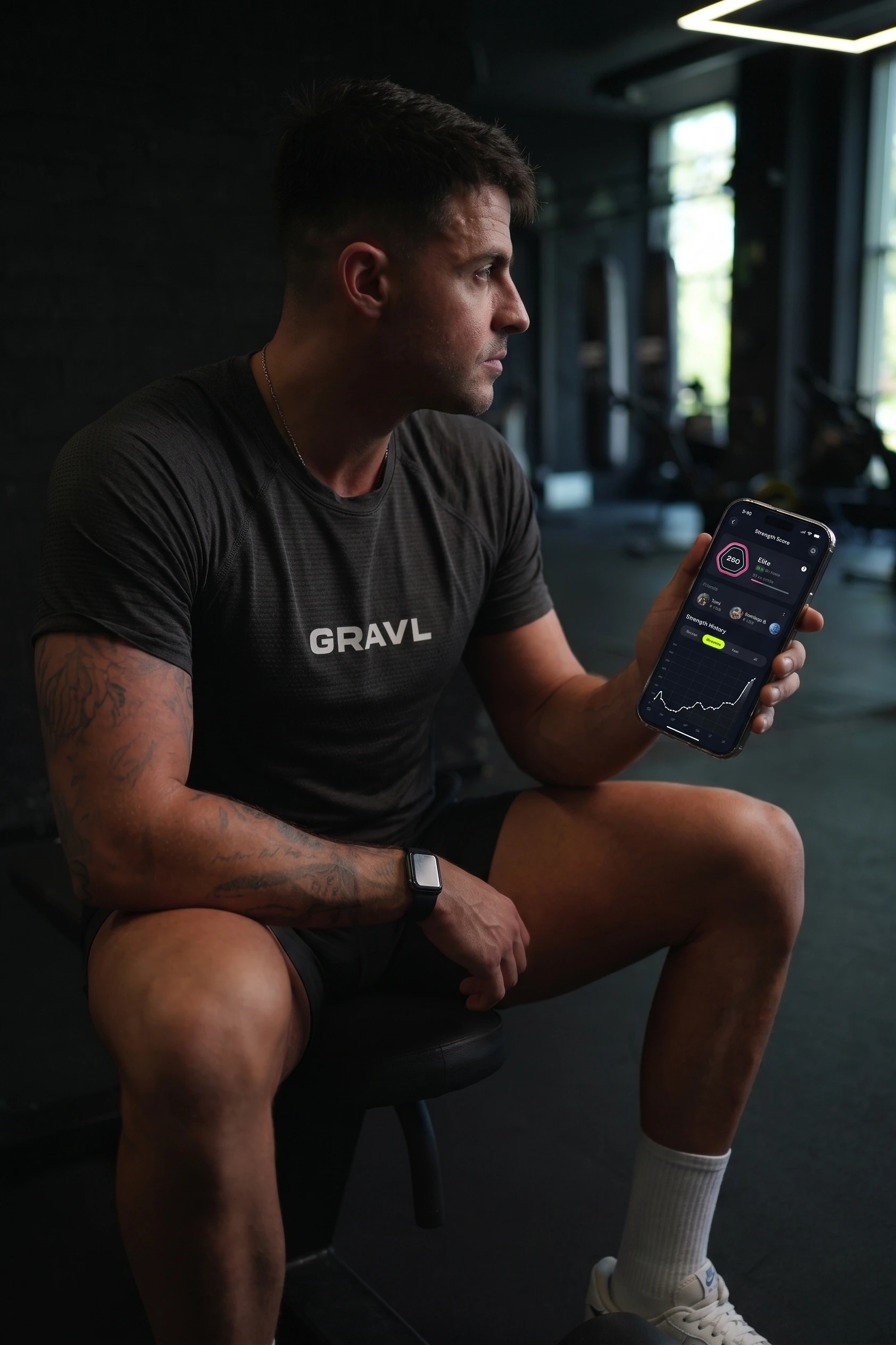
Hevy is a workout logger that can now also write your program, through Hevy Trainer in its Pro plan. Bevel is a health tracker for iPhone and Apple Watch that scores your sleep, recovery and strain, with a strength logger built in. Gravl is a training system: it plans your week, pre-fills the weight of every set and puts real coaches in your chat. Pick Hevy to log your own training, Bevel if recovery data is what you care about most, and Gravl if you want the training itself decided for you.
This is our own comparison, so read it knowing where we stand. Every Hevy claim below comes from hevyapp.com and its App Store listing, and every Bevel claim from bevel.health, its help center and its App Store listing, all checked in November 2026.
The short version
All three live on your phone and all three can log a lifting session, but they are built around different questions. Hevy asks "what did you do?". Bevel asks "how ready is your body?". Gravl answers "what should you do next?".
| Gravl | Hevy | Bevel | |
|---|---|---|---|
| Built as | A system that plans and progresses your training | A workout logger with a social feed | A health tracker for sleep, recovery and strain |
| Your program | Full week generated, recalculated after every session | Your own routines, or Hevy Trainer (Pro) | Your own routines, or generated plans |
| Working weights | Every set pre-filled, progression learned per lift | Hevy Trainer adjusts them (Pro) | Can copy last session's weights into a routine |
| Logging | Pre-filled sets, AI imports, logging on three watch platforms | Set types, rest timers, calculators, PR alerts | Routines, set types, RPE from your watch |
| Muscle recovery | Per muscle; the Recovery split trains what has recovered | No recovery model | Recovery and strain scores from your watch |
| Deloads | You set the dates and intensity | Optional, every 6 weeks (Hevy Trainer) | Not described |
| Human coaching | Real coaches in chat, in every plan | Only through a coach you hire on Hevy Coach | None described; AI assistant |
| Social | Friends, groups with challenges, leaderboards, Levels | Feed, follows, leaderboards on 38 lifts | A share card for workouts |
| Nutrition | Gravl Macros: photo, barcode or voice, targets that adapt | Not offered | Food logging with goals you set |
| Phones and web | iPhone, Android, web dashboard | iPhone, Android, web app | iPhone only |
| Watches | Apple Watch, Wear OS, Garmin | Apple Watch, Wear OS | Apple Watch; works with Garmin, Oura, Amazfit |
 Gravl
Where Hevy is genuinely good
Credit where it's due, and Hevy deserves a lot of it. The app has no ads, and hevyapp.com counts more than 18 million athletes and a 4.9 rating on both the App Store and Google Play. Its logging covers the essentials well: warmup, drop and failure sets, automatic rest timers, warmup and plate calculators, supersets, live personal record alerts and last session's numbers next to every set. Around that you get a social feed, progress photos, body measurements and a full web app at hevy.com.
Hevy Trainer: Hevy writes programs now too
Hevy now also has Hevy Trainer, and it changes the comparison. Trainer asks about your experience, goal, equipment, schedule and which muscles to prioritize, then generates a program with sets, rep ranges and rest times and adjusts your working weights as you log. Its rule is published: hit the top of the rep range on every prescribed set and the weight goes up. It can also schedule a deload after every six weeks of training, dropping the suggested weights by 40% (deloads are off by default). Trainer is part of Hevy Pro.
So "Hevy is just a notebook" is no longer true. If you enjoy writing your own program, or want a simple generated one, Hevy is a superb choice.
Where Gravl pulls ahead
The plan rebuilds itself after every session
Hevy Trainer generates a program and then adjusts the weights inside it. Gravl rebuilds the plan itself. It starts from your goal, your training days (1 to 7) and your session length (30 to 90 minutes), and recalculates the whole week after every session you log. On the Recovery split it keeps choosing the recovered muscles you trained least recently, so a skipped day or a short session gets made up in the next workouts. If you prefer a fixed structure, there are 9 preset splits and a custom split builder.
Progression that learns you, not a fixed rule
Hevy Trainer's rule is the same for everyone. Gravl uses double progression too (earn the reps, then the weight), but it learns lift by lift when you are ready for the next 2.5 kg (5 lb). Starting weights come from your sex, bodyweight and experience. After that they follow your performance, the effort you rate after each exercise, and the equipment at your gym. How Gravl picks your weights explains the details.
Logging that does the typing for you
Hevy's logging is good. Gravl's does more, mostly by doing the work for you. Every set arrives with its weight pre-filled, and warmup sets, supersets, dropsets, rest timers and a plate calculator are all there. Mid-session you can replace, reorder or queue exercises, pause the workout, and later log a session on a past date or fix a finished one. Then come the parts Hevy's feature list does not show: AI that imports a workout from an Instagram or TikTok post, a PDF or a photo; custom exercises built from a video link or just a name; custom equipment from a photo of the machine; exercise videos you can download for a gym with no signal; Workout Focus, which locks distracting apps until the session ends; and logging from Apple Watch, Wear OS or Garmin.
Recovery decides what you train
Hevy does not model recovery. Bevel measures it in depth and suggests when to train or rest. Gravl goes one step further for lifting: recovery per muscle decides which muscles today's workout trains, and the weights follow. Apple Health and Health Connect sync both ways, so a run or a ride you log elsewhere counts toward your muscle recovery. Deload periods work the same way: you pick the dates and the intensity, and the weights drop automatically.
A human when you need one
Hevy's coaching runs through Hevy Coach, a separate product, so you only get it if you hire a trainer who uses it. Bevel's coach is an AI assistant. Every Gravl plan includes real coaches who answer in the in-app chat, for the weeks when life does not match the algorithm. On top of that, Form Analysis (a paid feature) scores a clip of 10 seconds or less on form, tempo and range.
Friends who train with you, not just followers
Hevy's social side is a feed: you follow people, like and comment on their workouts, and see where you rank among them on a list of 38 key lifts. Gravl has the feed too, with claps and comments, and adds what gets friends to the gym. Groups bring your friends or your gym crew together around challenges on volume, workouts completed or Strength Score gained, and when a challenge ends the top three earn gold, silver and bronze badges. Every group runs a monthly challenge, and Hevy lists no groups or challenges at all.
You can also check how you stack up against your friends on any exercise, not a fixed list, and on Strength Score and streak leaderboards. Gravl Levels turns workouts, PRs and weekly goals into XP across seven levels, and a workout you send a friend imports straight into their app. Bevel's social side, as its help center describes it, is a share card for your strength workouts.
Training and food on one account
Hevy has no nutrition tracking. Bevel logs food in its app, with barcode scanning, photos and a database of over 6 million foods, against goals you set. Gravl Macros, on the same account as your training, does more of the work: you log food by photo, barcode or voice and check the detected foods before saving, it sets your calorie and macro targets from your body and goal and adjusts them over time, and it tracks your weight, body fat and progress photos with a trend line.
Hevy vs Bevel: which should you use?
If you are deciding between Hevy and Bevel, the honest answer is that they are good at different things. Hevy is the better lifting app: more set tools, Android and a web app, and a real social feed. Bevel is the better health app: sleep, recovery, strain and stress scores from your Apple Watch, food logging, and an AI assistant that reads all of it.
Bevel's Strength Builder is better than most people expect. It has routines, supersets and circuits, warmup, failure and drop sets, rest timers and a plate calculator. It syncs live between phone and watch, and it estimates the effort (RPE) of your sets from the watch's accelerometer. Your lifting also feeds its strain score, which a pure logger cannot do. Where it trails Hevy is depth for lifters: no custom equipment, no Android version, and no published rule for raising your weights.
| Hevy | Bevel | |
|---|---|---|
| Best at | Logging and following a lifting program | Sleep, recovery and strain |
| Strength tools | Set types, supersets, plate and warmup calculators, PR alerts | Routines, supersets, circuits, set types, RPE from your watch |
| Programs | Hevy Trainer (Pro) | Generated plans |
| Recovery and sleep | Not tracked | The core of the app |
| Nutrition | No | Yes |
| Phones | iPhone, Android, web | iPhone only |
| Social | Feed, follows, leaderboards | A share card for workouts |
Pick Hevy if lifting is the main thing you track, you use Android, or you like writing your own program. Pick Bevel if you already wear an Apple Watch day and night and care as much about sleep and recovery as about your lifts. Running both is reasonable too: Bevel on the wrist for recovery, Hevy in the gym.
And if what you want from either is a plan that follows your recovery and progresses every lift, with a coach on call, that is the gap Gravl fills.
The bottom line
If you love programming your own training and want a solid logger for it, Hevy will serve you well. If recovery and sleep are what you want to understand, Bevel is the specialist. If you want the programming done for you, weights picked, recovery watched, food tracked and a coach one tap away, that is exactly what Gravl is for.
The best test is the same for all three: run your next two weeks in one of them and watch what happens to the bar.
FAQ
Should I use Hevy or Bevel?
Use Hevy if your priority is logging and progressing your lifting, especially on Android. Use Bevel if you want sleep, recovery and strain scores from an Apple Watch, with a capable strength logger included.
Is Hevy better than Bevel for strength training?
For lifting alone, yes: Hevy has more logging tools, a web app, an Android version and a program generator with automatic weight increases. Bevel's advantage is that your lifting feeds a full picture of your recovery and strain.
Does Hevy create workout plans?
Yes. As of November 2026, Hevy Trainer, part of Hevy Pro, builds a program from your experience, goal, equipment and schedule, and adjusts your working weights as you log.
Is Bevel available on Android?
Not as of November 2026. Bevel's own site only offers the iPhone app, which pairs with the Apple Watch. The Android app called "Bevel Health" on Google Play comes from a different developer.
Can Gravl replace both Hevy and Bevel?
For training, yes: Gravl plans and logs your sessions, picks your weights, tracks recovery per muscle and connects to Gravl Macros for food. If sleep and stress scores are what you are after, that is Bevel's specialty, not ours.